Does Daily Brain Training Actually Work?

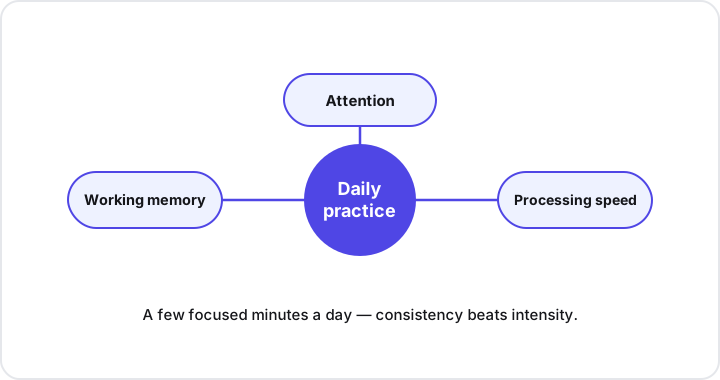
Yes — with an honest caveat. Daily brain training reliably improves the specific skills you practise, like working memory, attention and processing speed, and research suggests consistency matters more than intensity. What it usually won’t do is make you smarter in general, so be skeptical of any app promising a higher IQ.
That gap between “trains real skills” and “rewires your whole brain” is where most of the confusion lives. Below is what the evidence supports, what it doesn’t, and how to build a practice that actually sticks.
What the science supports
The strongest and least surprising finding is this: you get better at what you practise. Train working memory and your working-memory tasks improve; train attention and you hold focus longer; train processing speed and you respond faster. These are measurable, repeatable gains.
Two points are reasonably well supported by research:
- Working memory, attention and processing speed are trainable. They aren’t fixed traits — they respond to deliberate, repeated practice, much like a muscle responds to regular use.
- Consistency matters more than intensity. A few focused minutes most days tends to beat an occasional long session, because memory and attention respond best to regular, spaced practice rather than one-off cramming.
Why does this matter beyond the exercises themselves? Because these three skills quietly underpin a lot of everyday thinking:
- Working memory is the mental scratchpad you use to follow a conversation, do mental math, or hold the steps of a plan in your head.
- Attention is what lets you stay with one task instead of bouncing between tabs.
- Processing speed is how quickly you take something in and act on it.
Keep those sharp and ordinary cognitive tasks feel a little easier. That’s a modest, defensible claim — and a genuinely useful one.
What the science doesn’t support (yet)
Here’s the honest part. The big debate in brain training is about transfer: does getting better at a training task carry over to other abilities?
It helps to split transfer into two kinds:
- Near transfer — improving on tasks closely related to what you trained. This is well established. Practice a working-memory drill and similar working-memory tasks tend to improve too.
- Far transfer — improving on broadly unrelated abilities, like overall intelligence, school grades, or job performance. This is debated and frequently overstated, and the evidence is far weaker.
So when an app implies that a daily game will raise your IQ, boost your career, or hold off age-related decline, treat it with caution. The robust takeaway is narrower and more reliable: regular practice keeps the specific skills you train in good shape. Think of it like a short daily walk — it keeps you fitter and feels good, even if it won’t win you a marathon.
Being clear about this isn’t a downgrade. It’s what separates a useful habit from a marketing promise.
Why calm beats flashy
Many brain apps are engineered to maximise engagement: aggressive streaks, badges, leaderboards, loud animations, and a constant nudge to keep playing. That design can quietly work against you, because stress and distraction are the enemies of attention. An app that spikes your heart rate to keep you tapping is training the opposite of calm focus.
A better approach is quiet and deliberate:
- A small, well-chosen set of exercises rather than an endless arcade.
- A clear daily goal — and a clear point where you’re done.
- No manipulative pressure to extend the session.
The goal is a sustainable habit that supports your attention, not another app competing for it. Calm, minimalist practice is easier to keep up day after day, and it’s the keeping-up that produces results.
A quick honesty check for any brain app
Before you commit, ask:
- Does it claim to make you generally smarter? (Be skeptical.)
- Does it train identifiable skills you actually care about?
- Does it respect your time, or try to keep you hooked?
- Can you finish a session and feel calmer, not more wired?
How to build the habit
The science of consistency points to a simple, repeatable routine. The aim is to make showing up almost automatic.
- Pick a fixed time. Anchor the session to something you already do every day — your morning coffee, your commute, the start of lunch. A consistent cue does most of the work.
- Keep sessions short. A few focused minutes you’ll actually repeat tomorrow beats twenty minutes you’ll skip. Short is a feature, not a compromise.
- Track consistency, not scores. Your daily streak of showing up matters more than any single result. Skills compound through repetition, so protect the habit, not the high score.
- Don’t chase perfect days. Missed yesterday? Just do today. One gap doesn’t undo weeks of practice — quitting does.
A daily practice, done simply
This is the thinking behind QZBrain: a minimalist daily practice for a sharper mind. It trains working memory, attention and processing speed in short, calm sessions — no flashy gamification, no pressure to keep playing.
It’s also built to stay out of your way:
- Works offline, so a weak signal is never an excuse to skip.
- No account required — open it and start.
- Available on web, iOS and Android, so your practice travels with you.
Key takeaways
- Yes, daily brain training works — for the skills you train. Working memory, attention and processing speed are genuinely trainable.
- Consistency beats intensity. A few focused minutes most days outperforms occasional long sessions.
- Don’t overstate “far transfer.” Training is unlikely to raise general intelligence; be wary of apps that promise it.
- Calm beats flashy. Low-stress, minimalist practice is easier to sustain and kinder to your attention.
- Build a habit, not a streak obsession. Fixed time, short sessions, and just showing up are what compound over time.
Ready to try it the calm way? Give it a few minutes a day for a couple of weeks and notice how focus feels. Start with QZBrain — free, calm, offline-friendly, and ready whenever you are.