What Is Spaced Repetition and Why It Works

Spaced repetition is a learning technique that schedules reviews at gradually increasing intervals, so you revisit each fact just before you would forget it. It works because every successful recall makes a memory more durable, and reviewing at the right moment gives you the most retention for the least effort. The result is that you can hold thousands of facts in long-term memory with only a few focused minutes a day.
If you’ve ever crammed for an exam and forgotten almost everything a week later, you’ve already met the problem spaced repetition solves. Below is how it works, why it works, and how to actually put it into practice.
The forgetting curve
In the 1880s, Hermann Ebbinghaus ran experiments on his own memory and described what’s now called the forgetting curve: newly learned information decays over time, and the drop-off is steep at first. Without any review, much of what you learn slips away within days.
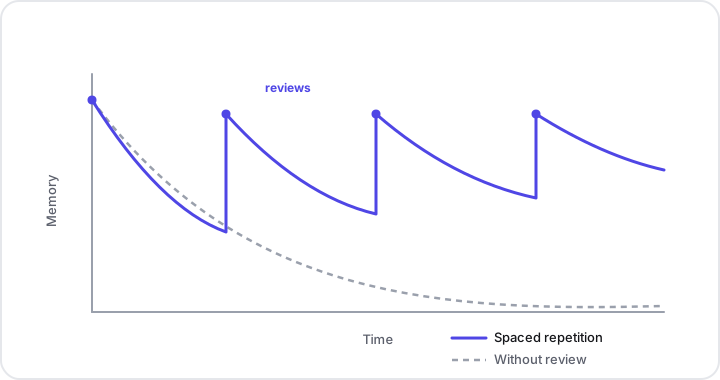
The important part isn’t the decay — it’s what happens when you review. Each time you successfully recall something, the curve flattens. The memory still fades, but more slowly than before, so the gap until your next review can grow longer and longer.
That single idea is what makes spaced repetition so efficient. Instead of reviewing everything constantly (most of it wasted on facts you already know), you review each item only when it’s actually at risk of being forgotten.
Active recall beats re-reading
Spaced repetition relies on a second principle: active recall.
Re-reading your notes or highlighting a textbook feels productive, but it mostly builds familiarity — a sense that you’ve seen something before. Familiarity is not the same as being able to produce the answer when you need it. Research on learning consistently suggests that effortful retrieval, not passive review, is what strengthens memory.
Active recall means forcing yourself to pull an answer out of your head before checking it:
- See a question or prompt.
- Try to answer it from memory, even if it’s hard.
- Reveal the answer and check whether you were right.
That moment of struggle is the point. The harder (but still successful) the retrieval, the more the memory is reinforced. Flashcards are the classic tool for this because each card is a tiny retrieval test. Spaced repetition then decides when you see each card again.
How the algorithm decides timing
Early spaced repetition systems used fixed intervals — review after 1 day, then 3 days, then a week, and so on. That’s better than nothing, but it treats every card the same and ignores how well you actually know each one.
Modern schedulers are smarter. The Free Spaced Repetition Scheduler (FSRS) models each card’s memory using three values:
- Retrievability — the probability you can recall the card right now.
- Stability — how long the memory will last before retrievability drops to a given level.
- Difficulty — how hard the material is for you, which affects how much each review improves stability.
Scheduling to a target retention
FSRS uses those values to predict when a card’s retrievability will fall to your target retention — commonly around 90%. It schedules the next review for roughly that moment: late enough that the recall is effortful (which strengthens the memory), but early enough that you don’t forget it entirely.
Because the algorithm adapts to each card individually, it stops wasting your time on material you clearly know and concentrates on the cards at risk of slipping. In practice this means fewer reviews for the same level of retention — you keep the results while cutting the busywork.
Putting it into practice
The theory is simple, but a few habits make the difference between a system that compounds and one that quietly falls apart.
- Make atomic cards. One idea per card. “In what year did X happen?” is far better than a card that crams a whole paragraph onto the back. Atomic cards are easier to recall, easier to grade honestly, and let the algorithm schedule each fact precisely.
- Write cards that test recall, not recognition. Phrase the front as a real question, so you have to produce the answer rather than just recognize it.
- Be honest when you rate yourself. FSRS only schedules well if it knows what you actually remembered. Marking a card “easy” when you barely guessed it corrupts the model and you’ll see it at the wrong time.
- Show up daily. Short, consistent sessions beat occasional marathons. Spaced repetition assumes a steady cadence; if reviews pile up, the timing that makes it efficient breaks down. Even five or ten minutes a day keeps the system honest.
- Trust the schedule. Once cards are well written and graded honestly, resist the urge to over-review. Letting intervals grow is what frees up your time.
Key takeaways
- The forgetting curve shows memory decays over time, but each successful recall flattens it so the memory lasts longer.
- Active recall — retrieving an answer from memory — strengthens learning far more than re-reading or highlighting.
- Modern schedulers like FSRS model retrievability, stability, and difficulty to schedule each review at a target retention (commonly ~90%), giving the same retention with fewer reviews.
- Atomic cards, honest self-rating, and a daily habit are what make the method work in practice.
Try it yourself
The most reliable way to learn spaced repetition is to start using it. Flashcards World is built on FSRS, so your reviews are scheduled at the right moment automatically. It offers five study modes — classic, multiple choice, writing, drawing, and audio — and imports existing decks from Anki, Quizlet, CSV, or Excel, so you don’t have to start from scratch. It works offline and syncs across web, iOS, and Android, and it’s free (ad-free on the web).
Pick a deck, study honestly for a week, and watch how little time it takes to keep what you learn. Start studying on Flashcards World.