Why We Build Privacy-First, No-Upload Tools
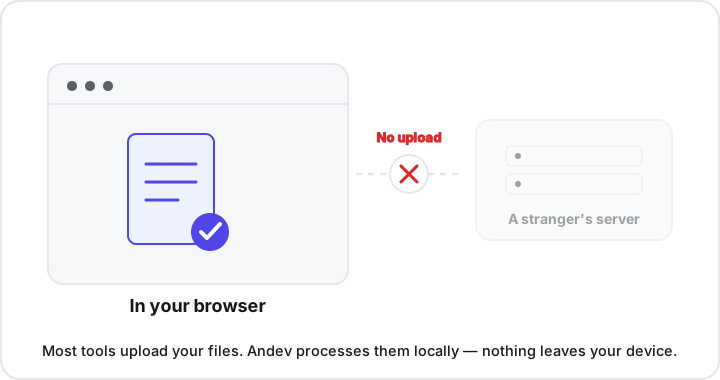
Most free online tools upload your files to a server, process them there, and send the result back — which means a stranger’s computer briefly holds your documents. Privacy-first tools do the opposite: everything runs inside your own browser, so your files never leave your device. At Andev, that’s the only way we build, and below is the full case for why.
How most “free” online tools really work
Search for “merge PDF,” “compress image,” or “convert to WebP” and you’ll get dozens of polished, free results. Use almost any of them and the same thing happens behind the scenes:
- Your file is uploaded to a server you know nothing about.
- It’s processed on that server.
- The result is sent back to you.
It works, and it feels instant enough. But it quietly asks you to trust an unknown company with the actual contents of your file — and to trust that they delete it, secure it, and never look at it.
That file might be a signed contract, a payslip, a medical scan, a passport photo, or a spreadsheet of customer data. Once it’s uploaded, you’ve lost control of it. You’re relying on a privacy policy you didn’t read, written by a company you can’t name.
“Free” usually means you’re the product
Servers that accept uploads, store files, and process them at scale cost real money to run. That cost has to be paid somehow, and with a “free” tool, the payment is often you.
It typically shows up as one of these:
- Advertising and trackers that follow you across the web.
- Data collection — your files, your email, your usage patterns — packaged and sold or used to train something.
- A bait-and-switch paywall, where the tool is free until you hit a watermark, a file-size cap, or a “sign up to download” wall right when you need the result.
None of that is malicious by definition. It’s just the business model that an upload-based architecture pushes you toward. When your files live on someone’s disk, they become a tempting asset to monetize — and a tempting target to breach.
The cleanest way to avoid all of it is to not collect anything in the first place. Andev doesn’t sell your data because we don’t collect it. There’s nothing in our hands to leak, log, subpoena, or sell.
The technology finally caught up
For a long time, “real” file processing genuinely needed a server. Browsers simply couldn’t crunch a large PDF or re-encode a high-resolution image fast enough. That era is over.
Modern browsers can now do the heavy lifting locally, thanks to a few key technologies:
- WebAssembly (WASM) runs compiled code at near-native speed, so a PDF engine or image codec can live right inside the page.
- Canvas decodes, resizes, and re-encodes images — JPG, PNG, WebP — without ever touching a network.
- Web Crypto handles hashing and encryption in the browser, securely and quickly.
Put together, these mean a PDF merger, an image compressor, a QR generator, or a hash tool can run entirely in the tab you already have open. So we asked the obvious question: if it can run on your device, why send it anywhere else?
What privacy-first actually buys you
Choosing client-side processing isn’t just a philosophical stance. It produces concrete, everyday benefits.
Confidentiality you don’t have to take on faith
A file that is never uploaded cannot be intercepted in transit, logged by a server, retained after you’re done, or exposed in a future data breach. The strongest privacy guarantee is architectural: the data simply isn’t there to lose. You don’t have to trust a promise — there’s no upload to worry about.
Speed, and the ability to work offline
Removing the server round-trip removes the slowest part of the process. There’s no upload progress bar, no queue, no waiting for a download. Results appear the instant you click. As a bonus, many in-browser tools keep working with no connection at all — handy on a plane, a train, or flaky hotel Wi-Fi.
Honesty by default
When there’s no server bill to cover and no data to harvest, the dark patterns disappear with them. That’s why our tools have:
- No account or sign-up to use them.
- No tracking pixels following you around.
- No watermarks, and no “upgrade to remove the limit” surprises.
The tool does exactly what it says, and then gets out of your way.
Where you’ll see this in practice
This isn’t an abstract policy — it’s how everything we make is built. The same no-upload approach runs through our free in-browser tools and our apps:
- Flashcards World builds and reviews study decks using FSRS-based spaced repetition, keeping your learning data on your device.
- My Location reads your GPS coordinates locally in the browser — your position isn’t sent off to be logged.
- QZBrain runs quizzes and brain-training in the page, without shipping your answers to a server.
Different problems, same principle: do the work where the data already is.
Key takeaways
- Most free online tools upload your files to a server; privacy-first tools process them entirely in your browser, so files never leave your device.
- “Free” often means you pay with ads, data, or a surprise paywall — an upload-based model nudges tools in that direction.
- WebAssembly, Canvas, and Web Crypto have made fast, fully client-side processing genuinely practical.
- The payoff is real: confidentiality you don’t have to trust, instant results that often work offline, and no accounts, trackers, or watermark traps.
- Andev doesn’t sell your data because it doesn’t collect it — there’s nothing to leak in the first place.
Try it for yourself
The best way to understand privacy-first tools is to use one. Open any of our free tools and watch what happens when you process a file: nothing uploads, results are instant, and your data stays put. The “no upload” badge isn’t marketing — it’s the architecture. You can read exactly what we do and don’t collect on our privacy page.
Your files are yours. We’d like to keep it that way.